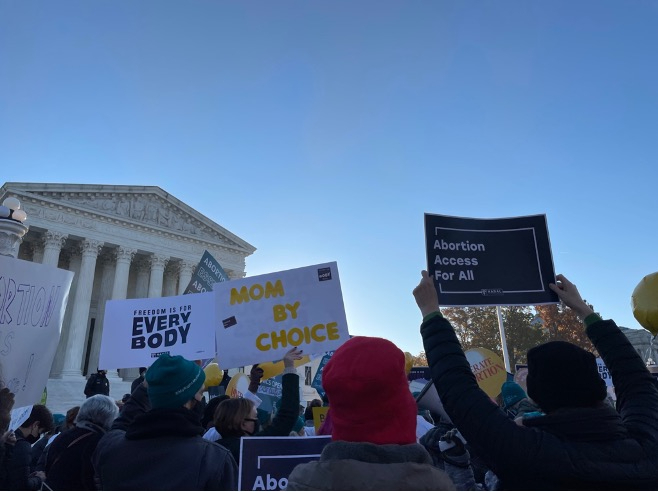
Pro-choice supporters chanting, “My life, my decision,” were met with counter-protestors shouting, “You women are going to bleed to death” outside the Supreme Court Wednesday morning.
By Lauren Berryman
Abortion access in America is now up for debate nearly 50 years after the U.S. Supreme Court’s landmark decision in Roe v. Wade. Whether to limit access will once again be up to the court, which now leans conservative.
The justices heard oral arguments Wednesday on the constitutionality of Mississippi’s state law that bans abortion 15 weeks after conception, or nine weeks before fetal viability. This case, Dobbs v. Jackson Women’s Health Organization, challenges the court’s decisions made in Roe v. Wade (1973) and Planned Parenthood v. Casey (1992).
“When an issue affects everyone and when the Constitution does not take sides on it, it belongs to the people,” said Scott Stewart, Mississippi’s solicitor general. “Roe and Casey have failed… This court should overrule Roe and Casey and uphold the state’s law.”
Julie Rikelman, senior director at the Center for Reproductive Rights representing Jackson Women’s Health Organization, explained that two generations have relied on Roe’s decision, which upholds a woman’s right to an abortion without government interference.
“One out of every four women makes the decision to end a pregnancy,” Rikelman said. She explained access to abortions up until the point of viability, which is when the fetus can survive outside the uterus, is essential because health, life and financial changes as well as when a woman learns she’s pregnant might happen after 15 weeks.
“To avoid profound damage to women’s liberty, equality and the rule of law, the court should affirm,” Rikelman told the justices.
Justice Brett Kavanaugh, who will likelyplay an influential role in the Supreme Court’s decision, clarified with Stewart that if the justices rule in favor of the state, then states could still allow abortions.
Stewart agreed and added, “I don’t think anybody would be moving to change their laws in a more restrictive direction.”
But those arguing against Mississippi’s ban, including Elizabeth Prelogar, the U.S. solicitor general representing the Biden administration, are worried some states will impose harsh abortion laws, if the Mississippi law is upheld.
“Nearly half of the states already have or are expected to enact bans on abortion at all stages of pregnancy, many without exceptions for rape or incest,” Prelogar told the justices.
Both Prelogar and Rikelman argued that the Constitution protects a woman’s reproductive rights.
“Preserving a woman’s right to make this decision [of abortion] until viability protects her liberty,” Rikelman said. “Eliminating or reducing the right to abortion will propel women backwards.”
Justice Clarence Thomas, who has long been critical of Roe’s decision, according to The Washington Post asked Rikelman and Prelogar what constitutional right protects the right to abortion.
The right to abortion is protected under the 14th Amendment’s access to equal liberty, which the court has interpreted to include the right to make family decisions, Rikelman and Prelogar separately responded.
“The court has never revoked a right that is so fundamental to so many Americans and so central to their ability to participate fully and equally in society,” Rikelman said. “The court should not overrule the central component of women’s liberty.”
Outside the Supreme Court Wednesday morning, Rebecca Gotwalt, a pro-choice supporter, said her access to an abortion changed —and saved— her life.
“Access to abortion when I was young let me go on with my life, get my education, get the friends I have now, get the job I have now,” Gotwalt, 47, said. “It made my entire life possible.”
Justice Sonia Sotomayor, who supports abortion access, asked Stewart why Mississippi wants to ban access to abortions before viability is determined, adding that it sounds like a religious interest.
Stewart fired back that the woman’s interest is still there. Rather, he said the decisions made in Roe and Casey prohibit states from weighing women’s interests.
But Jamie Lauer, who traveled to D.C. from Redstone, Colorado, to fight for women’s reproductive rights, said if it’s her body, then it’s her choice.
“What empowers me is that I’m a woman,” Lauer said. “I should be able to say what goes on with my body and my reproductive choices.”
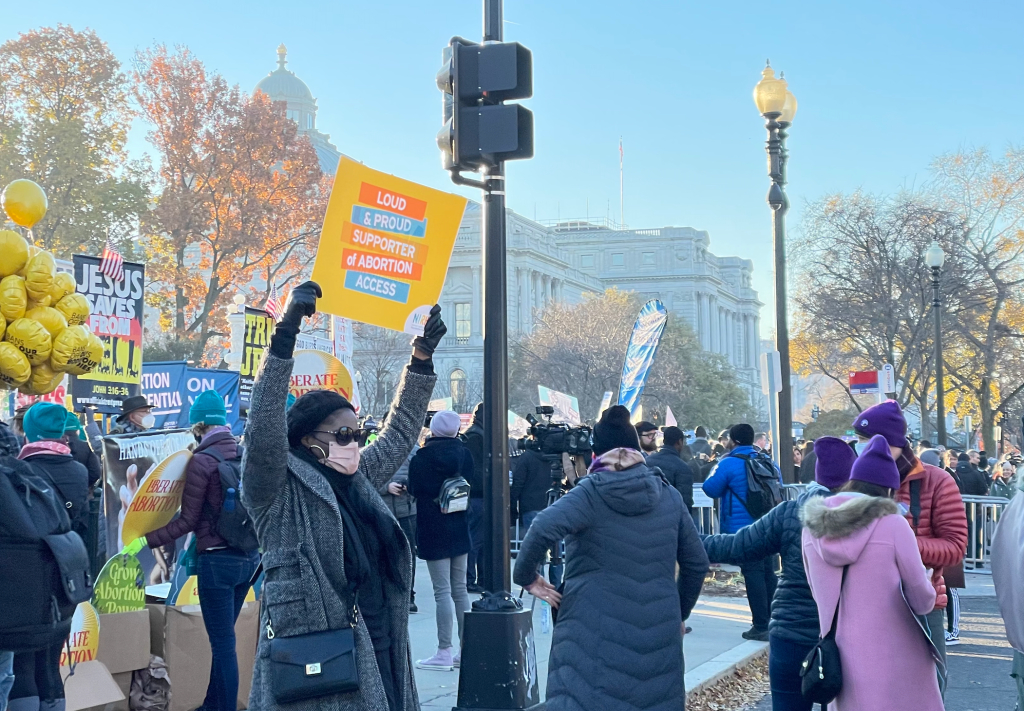
The views of demonstrators, like Lauer and Gotwalt, clashed with those from pro-life groups, including Created Equal.
Lexie Hall came with the group from Columbus, Ohio, to voice her opinion against abortion.
“We think it’s always wrong to intentionally kill an innocent human being,” Hall said. “Elective abortion is the intentional killing of a human being. Therefore, elective abortion is always wrong.”
She added that in the case of medical emergencies, women should opt for C-sections rather than abortions.
But to Hope Neyer, a junior at American University and organizer with the justice advocacy group, Shutdown D.C., abortion access is health justice.
“Abortion is freedom,” Neyer said. “It has become eminently clear to me that one of the frontlines in health justice right now is abortion access, so it’s very important to me to stand up in that way.”
The justices will decide the case, Dobbs v. Jackson Women’s Health Organization, next summer.
 Lauren Berryman